Showing posts with label hindustani. Show all posts
Showing posts with label hindustani. Show all posts
Monday, December 22, 2025


Wednesday, December 17, 2025
Monday, November 17, 2025
Tuesday, November 28, 2017
Bhajan by Kumar Gandhara
Shravanam with a difference!
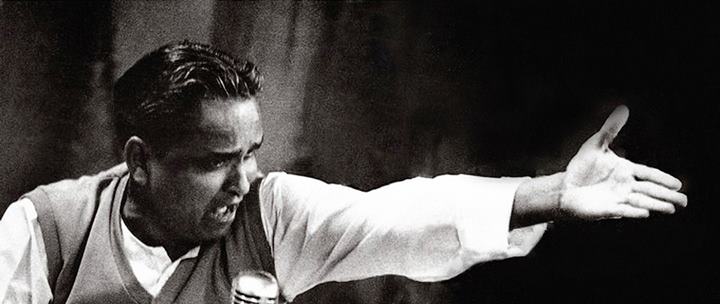
Kumar Gandhra is an unusual singer of Bhajans.
His Nirguni Bhajnas are a rage among devout.
This Bhajan talks about teh way a Bhajan is sung.
It is mystic.
It is Tantric.
It is exhilarating.
I liked it form the first time I heard it.
I am sure you will too like it.
It is short!
But very effective!


Kumar Gandhra is an unusual singer of Bhajans.
His Nirguni Bhajnas are a rage among devout.
This Bhajan talks about teh way a Bhajan is sung.
It is mystic.
It is Tantric.
It is exhilarating.
I liked it form the first time I heard it.
I am sure you will too like it.
It is short!
But very effective!

(Click to see it bigger)
Thursday, August 16, 2012
Enta Nerchina - Abdul Karim Khan
Shravanam of a rare piece!

Abdul Karim Khan sings Enta Nerchina Saphalamemi

Biography: Abdul Karim Khan
by Mohan Nadkarni
First Published in: The Economic Times, Bombay, October 24, 1982
Abdul Karim Khan strode the musical realm like a colossus for well over a generation in the early decades of this century. He not only gave a new elan to the history of Hindustani music, but also set a novel trend in classicism by making a fundamental departure from the several contemporary styles of traditional singing. In fact, the aesthetic virtues that marked his vocalism were all his own, not visualized or projected before. His music was sweet, soothing and serene. It was also sensuous and naturally avoided dramatic contrasts and tensions. Nor did it have a sense of massiveness and dignity. But such shortcomings, if they could be so-called, were more than overcome by an intensely emotional approach.
Two more and equally trend-setting departures from convention are the Ustad's innovation of a style of thumri which was again radically different from the orthodox, time-honored Purab ang; and his adaptation of Carnatic ragas to the Hindustani way. In the Ustad's voice, the Purab-ang thumri shed its erotic motivations and instead, acquired the character of a sad, pensive and devout supplication. The Carnatic adaptations, on the other hand, emerged with a new color and sparkle in the Hindustani garb. It was the kind of musical fusion, a genius like him alone could conceive, achieve and also popularize.
Predictably, the exuberance and freedom of Abdul Karim Khan's gayaki created an unprecedented stir among the orthodox milieu of the time. It brought him as many critics as votaries. To quote the late professor D.P.Mukherji, an eminent author, connoisseur and critic from = Bengal: ``Abdul Karim Khan would invite us to enter into the sanctum sanctorum of music where he was the high-priest. He was not an orthodox singer, He would not even sing a composition through. Hisasthayi was not always true to form. He would make unexpected permutations and combinations.... But who cared when Abdul Karim Khan was on the dais? This unorthodox man was a genius.... Some of the finest exponents of khayal today are either his pupils or his pupils' pupils''.
The validity of Dr.Mukherji's observations is resoundingly brought home by the brilliant array of his parampara. The list is rather too long to permit individual mention. Today, we have the fourth-generation exponents of his gayaki, who can be trusted, given certain conditions, to enrich and foster the parampara.
Born at Kirana, a village in the Kurukshetra region, now in Haryana, in 1872, Abdul Karim Khan migrated to south-west Maharashtra along with his brother, Abdul Huq, while he was still in his twenties. His new style grew in tremendous popularity despite the controversy that dogged him throughout his life. He received patronage from princely courts of Mysore and Baroda even while he moved from place to place in the course of his concert tours. It was during such concert tours that he attracted and groomed a large number of shagirds.
It is undeniable that the Kirana gharana, as we know it today, is the brain-child of Abdul Karim Khan. Precious little is, however, known about his forbears or their contribution. That is what makes him not only the pioneer but also the founder of the contemporary Kirana gayaki.
It is on record that the Ustad was not only a benevolent teacher but also a man of many parts a skilled shikari, a sensitive photographer and a top-notch exponent of the veena and the sarangi.
I was not lucky to hear the Ustad in flesh and blood. He has fortunately left behind numerous commercial discs which, according to old-timers who had heard him, do little justice. They remember him as a pilgrim of melody engaged in his eternal quest of swara one who did not create music but just flowered into it. As for me, I never tire of hearing his records even today.
(Thanks to the sources)
Sunday, July 15, 2012
Elchuri Vijaya Raghava Rao - Flute
Shravanam with Hindustani Flute

Happy listening!!
Pandit Vijaya Raghava Rao Presents a Gat in Malkauns

Happy listening!!
Tuesday, February 21, 2012
Gokulotsav Maharaj - Adbhut Ranjani
Shravanam Hindustani

There is nothing better than great music!!
@@@@@
Adbhut Ranjani by Goswami Gokulotsavji Maharaj

There is nothing better than great music!!
@@@@@
Sunday, January 29, 2012
Parween Sultana - Thumri
Shravanam - Thumri

Let us enjoy great music!!
@@@@
Begum Parveen Sultana renders a Bhairavi Thumri

Let us enjoy great music!!
@@@@
Sunday, November 27, 2011
Hariprasad Chourasia - Flute
Shravanam goes Hindustani way!

Let us enjoy great music!!
@@@@@
Sri Hariprasad Chourasia renders a Madhuvanti
Let us enjoy great music!!
@@@@@
Monday, November 14, 2011
Pannalal Ghosh - Shree
Shravanam of HM Flute!

Let us enjoy great music!!
@@@@@
Sri Pannalal Ghosh plays Raga Shree
(A Bengali musician, inventor of the modern long bansuri and pioneer of Hindustani classical music on bansuri.)
Let us enjoy great music!!
@@@@@
Tuesday, November 1, 2011
Zakir Hussain - Tabla Solo
Shravanam of Rhythm

Let us enjoy great music!!
@@@@@@
Ustad Zakir Hussain - Tabla Solo

Let us enjoy great music!!
@@@@@@
Thursday, October 20, 2011
Basavaraj Rajguru - Chandani Kedar
Shravanam Hindustani!

Let us enjoy great music!!
@@@@@
Sri Basavaraj Rajguru - Chandani Kedar
Let us enjoy great music!!
@@@@@
Wednesday, October 12, 2011
Malini Rajurakar - Bhairavi
Shravanam of a Thappa

Let us enjoy great Music!!
@@@@@
Smt Malini Rajurakar - Bhiaravi - Thappa

Let us enjoy great Music!!
@@@@@
Sunday, October 2, 2011

Thursday, September 8, 2011
Late Pandit Jagdish Prasad - Hameer
Shravanam pays belated tributes to the Maestro!

Jagdish Prasad (1937-2011)
Pandit Jagdish Prasad was initially groomed under the guidance of his father Pandit Badri Prasad, who was the court musician of the former principality of Raigarh, Madhya Pradesh. Later he was under the tutelage of none other than legendary artiste Ustad Bade Ghulam Ali Khan of Patiala gharana. Under the tutelage of both these Gurus, he enriched his repertoire in both classical and semi-classical music and could sing khayal and thumri with equal command.
He joined ITC-SRA in 1977. A gifted musician, he performed throughout the country and abroad. He left the Academy in 1984 and later joined Khairagarh University in Madhya Pradesh as a lecturer. He continued to serve the cause of music until his death on July 18, 2011 after a brief illness.
Let us honor the masters!
@@@@@@@

Pandit Jagdish Prasad sings Hameer
Jagdish Prasad (1937-2011)
Pandit Jagdish Prasad was initially groomed under the guidance of his father Pandit Badri Prasad, who was the court musician of the former principality of Raigarh, Madhya Pradesh. Later he was under the tutelage of none other than legendary artiste Ustad Bade Ghulam Ali Khan of Patiala gharana. Under the tutelage of both these Gurus, he enriched his repertoire in both classical and semi-classical music and could sing khayal and thumri with equal command.
He joined ITC-SRA in 1977. A gifted musician, he performed throughout the country and abroad. He left the Academy in 1984 and later joined Khairagarh University in Madhya Pradesh as a lecturer. He continued to serve the cause of music until his death on July 18, 2011 after a brief illness.
Let us honor the masters!
@@@@@@@
Tuesday, August 2, 2011
Ustad Rahim Fahimudin Dagar - Tributes
Shravanam pays homage to the maestro!

Look into this genealogy keenly!

I found this on the net!
Irfan Zuberi: Where did dhrupad originate from?
Ustad Rahim Fahimuddin Khan Dagar:
In the beginning, there were four forms - chhanda, prabandha, dhruva and matha. The remnants of these ancient forms are not to be seen in this day and age anymore. These then gave way to four styles - dhadhoo roop, miras roop, vant roop and jog roop which might still be in existence. All of this was part of a gradual development of music. These styles gave way to the four prominent stylistic affiliations or banis - dagar bani, khandar bani, nauhar bani and gauhar bani. This period would be roughly around the 12th century. The development and continuous additions and modifications to music were made by legendary sages like Nayak Gopal, Nayak Baiju and others. Among those who gave a sustained support to dhrupad was the great Maharaja Man Singh Tomar of Gwalior.
However, there exist competing views and controversies regarding who made which kind of contribution and how important a place that particular sage or master should occupy in the overall history of music. Some people say that Nayak Baiju had a competition with Swami Haridas Dagur but according to our family history, Nayak Baiju and Nayak Gopal lived during the Khilji dynasty whereas Swami Haridas Dagur lived during Akbar's reign. An esteemed friend of my father's and a great scholar Acharya Brahaspati once told me that he did a lot of research to come to the conclusion that Tansen was actually a Hindu. I congratulated him on his finding but wondered how it makes any difference to music in general and dhrupad in particular as both Muslims and Hindus have contributed immensely to music!
There is one important that people should know - there existed two individuals in the history of music both of which shared the name Swami Haridas but our ancestor was Swami Haridas Dagur who was also the guru of Tansen. By that link, the Senia gharana people are our guru-bhais since we share the same ancestral guru.
At the end of the day, these controversies, contradictions and bones of contention do not matter as it is the mool siddhant of music which is paramount in my mind since it lives forever whereas these debates die out with people.
IZ: You keep saying that dhrupad contains the full information of Indian classical music. Please elaborate on this.
Ust.RFD: As our great forefather Baba Behram Khan Dagar said, dhrupad is "ragatmak swaratmak, shabdatmak varnatmak, talatmak layatmak and rasatmak". It is due to these simple but deep reasons that dhrupad is both kalatmak and primarily vidyatmak. Practitioners of dhrupad also require an in-depth knowledge of nada yoga. So you see, dhrupad is an educational subject which is both theory and practice at once!
IZ: You often also say that "ved ka upved hai sangeet". Please explain this.
Ust.RFD: Think of the Vedas as vidhi and sahitya or information. Then, the upveda can be thought of as kriya or the practical form of the Vedas which is sangeet. There are four broad chapters within sangeet - prakaran adhyaya, vadya adhyaya, nritya adhyaya and taal adhyaya.
What can be called the mool mantra or the formula of the prakaran adhyaya is the following:
"Om antaram twam, taran taaran twam, anant hari narayan om"
Alaap is practiced using this mool mantra in the apabhransh roop employing scientific ways of pronunciation - taalu, oshti, jibya, danti, maurdhani, nasika, anu nasika and niran nasika. Further, there are five vidhis to present the alaap in the nadatmak form - eekaar, ookaar, naakaar, saakaar and taakaar.
All of these are practical things and I love to demonstrate these things for the young of the country because it is on their shoulders now that this rich tradition rests. It is only if we light a candle today that more candles will get lit by themselves in the future. At the same time, these are things which are absolutely essential for musicians to know for music cannot be presented effectively and comprehensively without the detailed knowledge of these things.
There is a wonderful chautaal (12 beat cycle) composition by Bilas Baras Sen (elder son of Miyan Tansen) in Raga Miyan ki Todi which is self-explanatory:
Sthayi - "Kaun bharam bhoole ho man gyaani
Poochhat raag akshar budh baani"
Antara - "An jaani kachhu na jaani
Jaani na jaat vidya bahut sayaani"
IZ: I have found that you are very interested in reading about other religions and poetry. Do share this interest of yours with us.
Ust.RFD: I have always been interested in gaining more and more knowledge! Things which are put simply but have an inherent depth in them attract me towards themselves. All the literature which has within itself the search for the essence of the Almighty interests me. I like the works of Maharishi Valamiki, Maulana Jalaluddin Rumi, Kabirdas, Tulsidas, Zauq, Mirza Ghalib, Mir, Momin and Dagh. They have all said things which seem so simple but when pondered upon, they open the doors to wisdom and deep insight. I give you a couple of examples:
Kabirdas - "Har har bhaje to kuchh na hoi
Har ko bhaje to har ka hoi"
Kabirdas - "Jaisee jaaki bhaavna vaiso vako phal"
Tulsidas - "Ye gun saadhan ten nahin aai
Tumri kripa koi koi pai"
It is the things which make me go "aah" rather than "wah" which attract me most as the former is the voice from within the depth of the soul whereas the latter is merely a vocal appreciation.
May the maestro rest in Peace!!
@@@@@
Ustad Rahim Fahimuddin Dagar renders Adbhut Kalyan

Look into this genealogy keenly!

Irfan Zuberi: Where did dhrupad originate from?
Ustad Rahim Fahimuddin Khan Dagar:
In the beginning, there were four forms - chhanda, prabandha, dhruva and matha. The remnants of these ancient forms are not to be seen in this day and age anymore. These then gave way to four styles - dhadhoo roop, miras roop, vant roop and jog roop which might still be in existence. All of this was part of a gradual development of music. These styles gave way to the four prominent stylistic affiliations or banis - dagar bani, khandar bani, nauhar bani and gauhar bani. This period would be roughly around the 12th century. The development and continuous additions and modifications to music were made by legendary sages like Nayak Gopal, Nayak Baiju and others. Among those who gave a sustained support to dhrupad was the great Maharaja Man Singh Tomar of Gwalior.
However, there exist competing views and controversies regarding who made which kind of contribution and how important a place that particular sage or master should occupy in the overall history of music. Some people say that Nayak Baiju had a competition with Swami Haridas Dagur but according to our family history, Nayak Baiju and Nayak Gopal lived during the Khilji dynasty whereas Swami Haridas Dagur lived during Akbar's reign. An esteemed friend of my father's and a great scholar Acharya Brahaspati once told me that he did a lot of research to come to the conclusion that Tansen was actually a Hindu. I congratulated him on his finding but wondered how it makes any difference to music in general and dhrupad in particular as both Muslims and Hindus have contributed immensely to music!
There is one important that people should know - there existed two individuals in the history of music both of which shared the name Swami Haridas but our ancestor was Swami Haridas Dagur who was also the guru of Tansen. By that link, the Senia gharana people are our guru-bhais since we share the same ancestral guru.
At the end of the day, these controversies, contradictions and bones of contention do not matter as it is the mool siddhant of music which is paramount in my mind since it lives forever whereas these debates die out with people.
IZ: You keep saying that dhrupad contains the full information of Indian classical music. Please elaborate on this.
Ust.RFD: As our great forefather Baba Behram Khan Dagar said, dhrupad is "ragatmak swaratmak, shabdatmak varnatmak, talatmak layatmak and rasatmak". It is due to these simple but deep reasons that dhrupad is both kalatmak and primarily vidyatmak. Practitioners of dhrupad also require an in-depth knowledge of nada yoga. So you see, dhrupad is an educational subject which is both theory and practice at once!
IZ: You often also say that "ved ka upved hai sangeet". Please explain this.
Ust.RFD: Think of the Vedas as vidhi and sahitya or information. Then, the upveda can be thought of as kriya or the practical form of the Vedas which is sangeet. There are four broad chapters within sangeet - prakaran adhyaya, vadya adhyaya, nritya adhyaya and taal adhyaya.
What can be called the mool mantra or the formula of the prakaran adhyaya is the following:
"Om antaram twam, taran taaran twam, anant hari narayan om"
Alaap is practiced using this mool mantra in the apabhransh roop employing scientific ways of pronunciation - taalu, oshti, jibya, danti, maurdhani, nasika, anu nasika and niran nasika. Further, there are five vidhis to present the alaap in the nadatmak form - eekaar, ookaar, naakaar, saakaar and taakaar.
All of these are practical things and I love to demonstrate these things for the young of the country because it is on their shoulders now that this rich tradition rests. It is only if we light a candle today that more candles will get lit by themselves in the future. At the same time, these are things which are absolutely essential for musicians to know for music cannot be presented effectively and comprehensively without the detailed knowledge of these things.
There is a wonderful chautaal (12 beat cycle) composition by Bilas Baras Sen (elder son of Miyan Tansen) in Raga Miyan ki Todi which is self-explanatory:
Sthayi - "Kaun bharam bhoole ho man gyaani
Poochhat raag akshar budh baani"
Antara - "An jaani kachhu na jaani
Jaani na jaat vidya bahut sayaani"
IZ: I have found that you are very interested in reading about other religions and poetry. Do share this interest of yours with us.
Ust.RFD: I have always been interested in gaining more and more knowledge! Things which are put simply but have an inherent depth in them attract me towards themselves. All the literature which has within itself the search for the essence of the Almighty interests me. I like the works of Maharishi Valamiki, Maulana Jalaluddin Rumi, Kabirdas, Tulsidas, Zauq, Mirza Ghalib, Mir, Momin and Dagh. They have all said things which seem so simple but when pondered upon, they open the doors to wisdom and deep insight. I give you a couple of examples:
Kabirdas - "Har har bhaje to kuchh na hoi
Har ko bhaje to har ka hoi"
Kabirdas - "Jaisee jaaki bhaavna vaiso vako phal"
Tulsidas - "Ye gun saadhan ten nahin aai
Tumri kripa koi koi pai"
It is the things which make me go "aah" rather than "wah" which attract me most as the former is the voice from within the depth of the soul whereas the latter is merely a vocal appreciation.
May the maestro rest in Peace!!
@@@@@
Wednesday, June 15, 2011
Asad Ali Khan - Been
Shravanam with a Khamaj

"Rudra Veena exponent Ustad Asad Ali Khan, one of the last existing advocates of the Khandarbani dhrupad school, passed away yesterday. He was 74.
The classical musician who represents the 12 generations of Jaipur's Beenkar Gharana breathed his last at the All India Institute of Medical Science at around 2:30 a.m on 14 June 2011; his adopted son and disciple Ustad Ali Zaki Haidar said.
“I had taken Ustad ji to hospital in the evening for a routine check-up and he was admitted around 7 p.m. They conducted routine tests. Around 2 a.m. while he was watching TV in his air-conditioned room, I noticed he was sweating. He passed away a little later,” Ustad Haidar said.
Ustad Khan who was unmarried is survived by his nephew Haidar whom he had adopted as his own son at a very young age and trained to become his successor, said Pawan Monga, a disciple of the Rudra Veena exponent.
The musician, who received the Padma Bhushan in 2008 underwent training under his father Ustad Sadiq Ali Khan Beenakar. His father, grandfather Ustad Musharraf Ali Khan Beenakar and great-grandfather Ustad Rajab Ali Beenakar were court musicians in the princely state of Alwar where Ustad Asad Ali Khan was born in 1937.
His father later moved to the princely court of Rampur where he undertook to teach him music. For the next 15 years he learnt to play Rudra Veena, practicing 14 hours a day.
Ustad Khan was an artiste of the All India Radio and participated in 'sangeet samelans' and musical performances across the country and the world. He has also performed at concerts in Afghanistan, Australia, Holland, Italy, New Zealand, the UK, the USA and other countries": PTI
May his soul rest in peace!!
Let us enjoy great music!!
@@@@@@

Ustad Asad Ali Khan renders a Khamaj on Been
"Rudra Veena exponent Ustad Asad Ali Khan, one of the last existing advocates of the Khandarbani dhrupad school, passed away yesterday. He was 74.
The classical musician who represents the 12 generations of Jaipur's Beenkar Gharana breathed his last at the All India Institute of Medical Science at around 2:30 a.m on 14 June 2011; his adopted son and disciple Ustad Ali Zaki Haidar said.
“I had taken Ustad ji to hospital in the evening for a routine check-up and he was admitted around 7 p.m. They conducted routine tests. Around 2 a.m. while he was watching TV in his air-conditioned room, I noticed he was sweating. He passed away a little later,” Ustad Haidar said.
Ustad Khan who was unmarried is survived by his nephew Haidar whom he had adopted as his own son at a very young age and trained to become his successor, said Pawan Monga, a disciple of the Rudra Veena exponent.
The musician, who received the Padma Bhushan in 2008 underwent training under his father Ustad Sadiq Ali Khan Beenakar. His father, grandfather Ustad Musharraf Ali Khan Beenakar and great-grandfather Ustad Rajab Ali Beenakar were court musicians in the princely state of Alwar where Ustad Asad Ali Khan was born in 1937.
His father later moved to the princely court of Rampur where he undertook to teach him music. For the next 15 years he learnt to play Rudra Veena, practicing 14 hours a day.
Ustad Khan was an artiste of the All India Radio and participated in 'sangeet samelans' and musical performances across the country and the world. He has also performed at concerts in Afghanistan, Australia, Holland, Italy, New Zealand, the UK, the USA and other countries": PTI
May his soul rest in peace!!
Let us enjoy great music!!
@@@@@@
Subscribe to:
Posts (Atom)