Showing posts with label padyam. Show all posts

Friday, September 26, 2025

My words about Viswanatha Satyanarayana garu - (In English) Part 1

My words about 

Viswanatha Satyanarayana  garu


This piece is in English.
Wrote this on the request of a friend .

Listen to it please!
You will understand the great man.

Tuesday, August 19, 2025

లోకాభిరామం - పద్యంవిద్య - Lokabhiramam - Padyamvidya

లోకాభిరామం - పద్యంవిద్య


నా పుస్తకం నుంచి మరో వ్యాసం - మీ కోసం

పద్యంవిద్య

రాస్తారా అన్నప్పుడు,

చూస్తానంటే తప్పని, రాస్తానన్నా!

రాస్తే ఏమవుతుందో,

చూస్తాననుకున్నానూ, రాస్తున్నాను!

- ఇది కంద పద్యమేనా? ఏమో? నాకు తెలియదు. రాశాను, అంతే.

నాకు పద్యం రాయడం వచ్చునని చెప్పడానికి కాదు, ఈ పద్యం రాసింది. పద్యం గురించి రాయాలని అనుకుంటుంటే, పద్యం వచ్చింది. నండూరి రామకృష్ణమాచార్యుల వారు మంచి మిత్రులు. ఆయనకు మాట్లాడినంత సులభంగా పద్యం చెప్పడం వచ్చునంటే అతిశయోక్తి కాదు. వచనం (కథ, నవల, వ్యాసం) రాయడం గాల్లో విమానం నడపడం లాంటిదనీ, పాట రాయడం, రోడ్డు మీద కారు నడపడం లాంటిదనీ అన్నారాయన. ఇక పద్యం, పట్టాల మీద రైలు నడక అన్నారు కూడా. కొంచెం పట్టుంటే, వెళ్లవలసిన చోటికి అదే వెళుతుంది! అన్నారాయన. ఏ పనయినా అంతే, చేతనయిన వారికి, చాలా సులభంగానే కనపడుతుంది. మిగతా వాళ్లకది చెక్కల బావిలో మోటార్‌ సైకిల్‌ నడిపినట్లుంటుంది.

చెక్కలతో బావి కట్టి, అందులో గోడల మీద, సైకిల్‌, మోటార్‌ సైకిలూ, నడిపిన గురుభిక్‌సింగ్‌ ప్రదర్శన నాకు ఇన్నేళ్లయినా గుర్తుంది. ఆయనకదే బతుకు. (బహుశ: దాని అంతం కూడా!) ఎట్లా నడుపుతారు, అంటే, ‘ఓస్‌! సులభం’ అంటారని నా అనుమానం. పద్యం రాయడంలో మొత్తానికి ప్రమాదం మాత్రం లేదు. కనుక, నాతో మొదలు ఎవరయినా ప్రయత్నించవచ్చు. జారిపడినా దెబ్బలు తగలవు!

చిన్నప్పుడు, అదెందుకో, ఏమిటో తెలియకుండానే, శతకాలకు శతకాలు భట్టీయం (ఇది నోటికి నేర్చుకునే విద్య!) వేయించేవారు. ఇది పక్కనే పెడితే, మా ఊరి బడి ఒక సెంటర్‌ స్కూలట. సెంట్రల్‌ కాదని మనవి. చుట్టుండే అయిదారు పల్లెలకు అది కేంద్రమని అర్థం! ఆ బడులలో పంతుళ్లు వచ్చి ఒక ‘సెంటర్‌ క్లాస్‌’ అనే కార్యక్రమంలో ‘మాదిరి తరగతి’ అనే మాడల్‌ క్లాసులు నిర్వహిస్తుండేవారు. ఇది కూడా పక్కనబెడితే, ఈ బడులన్నింటికీ కలిపి ఆటల పోటీలు కూడా పెట్టేవారు. అంతటితో ఊరుకుంటే పోదూ? నాలాంటి ఆటలు చేతగాని మొద్దబ్బాయిల కోసం, పద్యాల పోటీ పెట్టారు. అమాయకులు, కొందరు అందులో పాల్గొంటామని పేర్లు ఇచ్చారు కూడా. మన సంగతి తెలియదులాగుంది. వాళ్లంతా, నట్టుతూ, ముక్కుతూ మూడు నాలుగు పద్యాలు చదివి, అలసి ఆగిపోయారు. నేను మాత్రం, వద్దన్నా ఆపకుండా, మొత్తం శతకం ఒకటి చదివినట్టున్నాను. అది మూడవ, నాలుగవ తరగతిలో ఉన్నప్పటి మాట!

సినిమా పద్ధతిలో సీన్‌ కట్‌ చేస్తే, ఎనిమిదవ తరగతిలో తేలుతుంది. యాదగిరాచార్లు గారు తెలుగు చెపుతారు. చాలా బాగా చెపుతారు. శ్రావ్యంగా పద్యం చదువుతారు. పద విశ్లేషణ, అంటే పదాలను విడగొట్టి చూపడం, తరువాతి అంచె. అర్థం చెప్పడం, సమన్వయం, ఆ తరువాత జరుగుతాయి. పద్యాన్ని మరో సారి చదువుతారు. అప్పుడు పిల్లలను చదవమంటారు. అందరూ వరుస తరువాత వరుసగా, ఒక క్రమంలో కూచుంటారు గదా! రెండు బెంచీలు మాత్రం కుడి పక్కన గోడ వెంట ఉండేవి. అందులో మొదట్లోనే నేను ఉండేవాణ్ని! అందరికంటే ముందు లేచి పుస్తకం అవసరం లేకుండానే, ఆ పద్యం చదివేవాణ్ని! అట్లా నడుస్తూనే ఉంది. మరీ చాలాకాలం నడిస్తే ఎందుకు గుర్తుంటుంది సంగతి? క్లాసులో ఉండే ఆడపిల్లలలో ఇద్దరు, ఇదంతా నచ్చలేదనుకున్నారు. ‘మీరు ఏ పద్యం చెప్పబోతున్నారో ముందే వాడికి చెపుతారు. వాడది ఇంట్లో నేర్చుకుని వస్తాడు! బడాయి!’ అన్నారు. ఆచార్లు గారికి నేనంటే, ఆనాటికీ, ఈనాటికీ అభిమానమే. ‘ఎందుకు ఉడుక్కుంటారు? నేను చెప్పినంత సేపు, అతను పద్యం మనసులో మననం చేసుకుంటాడు. మీరు చేయరు. అంతే!’ అన్నారు. సిలబస్‌లో లేని పాఠం ఒకటి తీసి అందులో పద్యం చెప్పడం మొదలుపెట్టారు. అలవాటు కొద్దీ, వంతు రాగానే, నేను పద్యం అప్పజెప్పాను. పుస్తకం లేకుండానే! ఆ తరువాత ఏమయిందో నాకు గుర్తులేదు.

బడిలో నాతోబాటు పద్యాల పోటీలో పాల్గొన్న మిత్రుడు, బంధువు విష్ణు, చెప్పా పెట్టకుండా మిలిటరీలోకి వెళ్లిపోయాడు. వాళ్లకు ఉత్తరాలు రాసే పద్ధతి విచిత్రంగా ఉంటుంది. మొత్తం చిరునామా ఎవరికీ ఇవ్వరు. పేరుతోబాటు ఒక నంబరేమయినా ఉండేదేమో? గుర్తు లేదు. ఫలానా శర్మ, కేరాఫ్‌ 56, ఎ.పి.ఓ. అని రాస్తే చాలు, ఉత్తరం వెళ్లిపోతుంది. ఏపీఓ అంటే ఆర్మీ పోస్ట్‌ ఆఫీస్‌ అని తరువాత తెలిసింది. (తెలిసిందా?) 56 అంటే విష్ణు ఉండే చోటయి ఉంటుంది. ఈ సంగతంతా పక్కన పెడితే, ఒకసారి ఉగాదికో, సంక్రాంతికో వాడికి ఇన్‌లాండ్‌ లెటర్‌ నిండా పద్యాలతో ఉత్తరం రాశాను. ఒక కాపీ ఉంచుకోవాలని తోచలేదు. వాడి దగ్గర గానీ, ఉందేమో ఉత్తరం, అడగాలి!

చిన్నాయనగారు కొంతకాలం పాతకాలం పద్ధతిలో ‘వసుచరిత్ర’ పాఠం చెప్పారు. ఇంట్లో, సంధులు, సమాసాలు, అలంకారాలు, పద్యవిద్య ఎన్నెన్నో పరోక్షంగా నేర్పించే పద్ధతి అది. బడిలో కూడా ఇట్లా చెప్పాలనే అనుకుంటారు కానీ, ఎందుకో అది కుదరదు. దేనికదే వేరువేరుగా ఉండిపోతయి. మొత్తానికి వసుచరిత్ర, మనుచరిత్ర, ఆశ్వాసాల మీద ఆశ్వాసాలు నోటికి వచ్చేవి. ‘అన విను, గృహస్థ రత్నంబ! లంబమాన రవిరథతురగ..’ అంటూ వచనమంతా ఒక్క పట్టున అప్పజెబితే అదొక ఆనందం. అమరకోశం, శబ్దమంజరి లాంటివి అంతకు ముందు నుంచే అభ్యాసంలో ఉండేవి. అప్పుడే అప్పకవీయం పరిచయమయింది. పద్యాల లక్షణాలను పద్యాల రూపంలో చెప్పే పుస్తకమది. నిడుదలు, జడ్డక్కరములు, పిరుందకడ యూదిన యక్కరముల్‌ గురువులు. కానివి లఘువులు. ఈ గురు లఘువుల కాంబినేషన్‌తో గణములు, గణముల కాంబినేషన్స్‌తో వృత్తములు, పద్యములు. తరువాత డి.ఎన్‌.ఏ. గురించి చదువుతుంటే నాకిదంతా గుర్తుకు వస్తుండేది. ‘జరల్‌ జరల్‌ జగంబుకూడి సన్నుతిన్‌ రచింపగా, పరాజితార ధీరవీర పంచచామరంబగున్‌!’ పంచచామరం అనే పద్యం లక్షణం పంచచామరంలో!

రేడియోలో నౌకరీ కొరకు ఇంటర్‌వ్యూహము. ‘రామాండెమంటే, సామాండెమా? గొల్లేశమంత కథ!’ అని ఒక మాట. రామాయణం సామాన్యం కాదు! బయలాటలో వచ్చే గొల్లవేషమంత ఉంటుందని, అన్న మనిషి భావం! ఈ ఇంటర్‌వ్యూహము కూడా గొల్ల వేషమంత కథ. ప్రస్తుతం పద్యంలో ఉన్నాము గనుక, అందుకు సంబంధించిన ప్రసక్తి ఉంది గనుక అది గుర్తొచ్చింది. ఉద్యోగం సైన్సుకు సంబంధించింది. ముగ్గురు నిపుణులు నా బుర్ర తిన్నారు. చేతయినంత వరకు నేనూ వారి బుర్ర తిన్నాను. కైసర్‌ కలందర్‌ గారని ఒక అందమయిన పెద్దాయన, కమిటీ అధ్యక్షులు. ‘సైన్సు సరే! హాబీలేమిటి?’ అని అడిగారు. ‘తిండి, అమ్మాయిల’ గురించి చెబితే కుదరదు. కనుక ‘సంగీతం, సాహిత్యం’ అన్నాను. ‘ఒక పద్యం చెప్పగలవా?’ అన్నారాయన. ‘కలడుల్లోక మహా మహోగ్ర’ అంటూ వసుచరిత్రలోని పద్యం చదివాను. అందులో కలడు అని మొదట్లో, ఇలన్‌ అని చివర తప్పితే మిగతా మొత్తం ఒకే ఒక్క సంస్కృత సమాసం మరి! ‘అర్థం చెప్పగలవా?’ అన్నారాయన. ‘ఓ యస్‌’ అన్నాను. భయపడ్డారేమో, ‘వద్దులే’ అని మరేదో అడిగారు. నాకా ఉద్యోగం ఇస్తారని అక్కడే అర్థమయింది. అది మరో గొల్లవేషం కథ!

మళ్లీ మొదటికి వస్తే, రామకృష్ణమాచార్యుల వారికి, ఆలోచన ఏదయినా వస్తే వెంటనే ఒక కార్డు ముక్క రాయడం అలవాటు. నేనూ జవాబుగా ఒక కార్డు రాసేవాణ్ని. ఒకసారి ఆయన రాయవలసిందేదో రాసి, కార్డు వెనుక చిరునామా రాసేచోట పక్కన ఖాళీలో రెండు పద్య పాదాలు రాశారు. ‘శాంతి సంగరంబు, స్వాతంత్య్ర సమరాన, సగము కాలినట్టి సమిధ నేను’ అని మాత్రం రాశారాయన. జవాబుగా రాసిన కార్డు వెనుక నేనూ అదే పద్ధతిలో ‘కడమ సగముగాల్చి కవితా ప్రపంచాన, కారు చీకట్లను పారద్రోలె!’ అని రాసి పంపాను. నమ్ముతారో లేదో? కార్డు అందిన మరుక్షణం ఆయన ఆఘమేఘాల మీద వచ్చారు. నన్ను కౌగిలించుకున్నారు. ‘తెలుగు పద్యం’ గురించి నేను వేస్తున్న పుస్తకంలో, నీ పద్యం ఉండాలి!’ అన్నారు. పద్యం లేదు. అదే వేరే సంగతి!


Tuesday, September 24, 2019

Sumati Shatakam - padyam and Commentary


After a long time let us once again peep into the wisdom of Sumati Shatakam.
Baddena the poet addresses the good mind the Sumati…
Word of advice to an imbecile is an effort wasted after all ...

పగ వలదెవ్వరితోడను
వగవంగావలదు లేమి వచ్చిన పిదపన్
తెగనాడవలదు సభలను
మగువకు మనసియ్యవలదు మహిలో సుమతీ

Paga valadevvari tODanu
vagavangA valadu lEmi vacchina pidapan
teganADa valadu saBhalanu
maguvaku manasiyyavaladu mahilO sumatI

పగ = animosity
వలదు = not required
ఎవ్వరితోడను = with anyone
వగవంగావలదు = don’t cry or feel sad
లేమి = poverty
వచ్చిన = having come
పిదపన్ - after
తెగనాడవలదు = don’t criticise
సభలను = courts or meetings
మగువకు = to a woman
మనసు = heart
ఇయ్యవలదు = don’t give
మహిలో = on the land
సుమతీ = Oh the good minded one…

Here poet proposes four things to be avoided.
Three of them for the mind. And may be one more for the tongue…
Or is that also for the mind also?

Make friends and not enemies is the good advice here. Hatred or bickering with none that too. It is easy to understand. Even if anyone harms you, it is to forgive the person and forget the incident. You can live happily. If one carries the ill will in the heart, life becomes miserable. One keeps thinking of somehow squaring up the matter. It makes one venomous. Bad in nature! Ghalib says

Kuch is tarah zindagi ko asaan kar liya mein nay
Kisiko baksh diya, kisise maafi maang liya mein ne…

I made my life easier this way… some I have forgiven and with others I have apologized…
No time to make friends and keep smiling… where do you find it to fume and blow your top off?

Poverty of money is no poverty at all. I have been living as happily as anyone without much money in the pocket. Forget about the bank! As long as you control your needs you live happily. There is enough in this world for my needs and not for my greed. Once you had money. Now it is gone, isn’t it? It is better. Life is giving you a chance to taste poverty too. Otherwise you never know what hunger is! In poverty what little comes to hand appears great, if you can imagine. So poverty is not for lamenting. It is for being one with majority of humanity…

Do you go to meetings and congregations? Do you really? Somehow I find myself in meetings very often. They pull me there per force even. Poet says not to critical at such assemblies. Good about it. Listen what is spoken by the others. If you have a point against one or all of them, simply say so, but not keep raving there only. Many people feel that critics are seen as special people. They think that they are noticed better. Not exactly so. Criticism is good but at the right place and time only. That is why poet asks you to behave when a lot of people are around. All of them need not react well to your ranting even if it has substance.

Bah… Baddena too warns men to keep away from fairer sex. He asks men never to lose heart to one of that class. Was he a broken heart? He must have been one surely. Is the Shatakam meant to be read only by menfolk and not women? Every once in a while I find this question staring me in the face. Earlier days writers and poets never too womenfolk into account while composing their works.

A Sumati could be a man and equally well a woman! But the last part of the verse cautions men against falling in love with females! That was how the society behaved. Male chauvinism at every step…
I do not really know what love is. I also feel all these songs and dances in the name of love too absurd to be devoted time. But the world looks like is going round and round along the wheel called love. Anyone who was successful and lived happily can say that love is divine, love is God and all that kitsch. One failed or seen other fail would suggest a la Baddena.

A little verse goes with a longish commentary perhaps. Tell me if you find this meaningful at all.


 Vijayagopal....

Monday, November 24, 2014

Vemana Padyam

After a long time I am posting one verse of Vemana here.


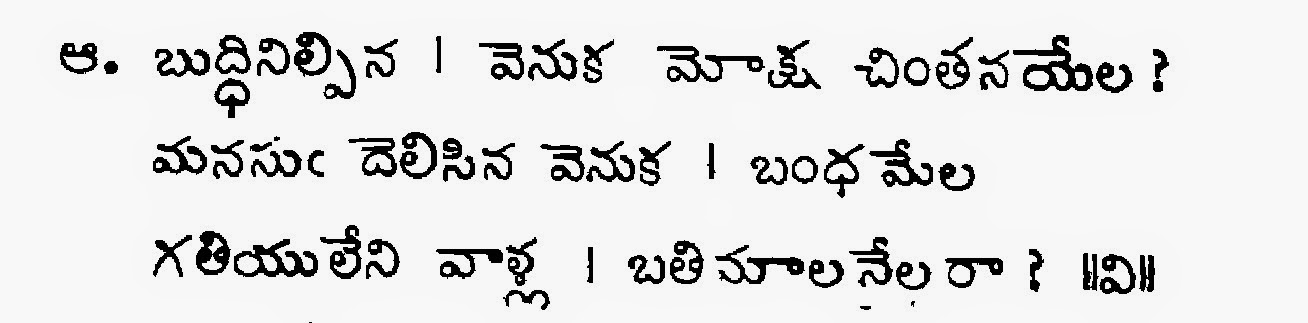
buddhi nilipina venuka mOksha cintanamEla
manasu delisina venuka bandhamEla
gatiyu lEni vaLLa batimAlanElarA
viswadabhirAma vinura vEma

buddhi nilipina venuka = once the mind is held in one place
mOksha cintanamEla - why think of salvation
manasu delisina venuka = once you know the heart (intention)
bandhamEla  = why bonds
gatiyu lEni vaLLa = to those who do not have means for themselves
batimAlanElarA = why beg

Vemana talks philosophy as is his wont. 
He says why think of unreachable things like salvation etc., usually discussed by enlightened people, if you are already able to hold your crafts. Once you know what you want and are able to control the desires salvation and bonds are easy things to achieve and break in that order.

If you are begging for alms, you should know from whom you are such magnanimity. if you stretch hand s before people who are themselves in need, you would end up with your empty hands.
the hands that are to give are empty. How can they fill your hands?

One should know ones inner strengths, requirements and what is expected and who can give it.
This all leads to a discussion about knowledge of self.
A simple verse has a lot to expound.


Tuesday, January 24, 2012

Vemana Padyam

After some gap, here is another padyam of Vemana.

mATalADagalgu marmamulerigina
pinna peddatanamu lenna valadu
pinna cEti divve peddaga velugadA
viswadAbhirAm vinura vEma


మాటలాడగల్గు మర్ముములెరిగిన 
పిన్న పెద్దతనము లెన్న వలదు
పిన్న చేతి దివ్వె పెద్దగ వెలుగదా
విశ్వదాభిరామ వినుర వేమ


మాటలాడగల్గు = the capability of communicating
మర్ముములు = intricacies
ఎరిగిన = knowing
పిన్న పెద్దతనములు = the age differences
ఎన్న వలదు = don't take into consideration
పిన్న చేతి దివ్వె = the torch in the hands of a youngster
పెద్దగ వెలుగదా = would it not burn bright

If the person knows the intricacies of communication, don't consider his age.
(Listen to him even if he is a youngster)
The torch in the hands of the youngster would as well burn bright.
It's glow would not diminish just because the person holding is young!


Vemana suggest that the qualities of people are more important than the age.
One who is young, if good at his craft, must be respected as well like the others in the trade.
Here the poet is particularly mentioning the capability of talking.
He is going a little deeper talking about the intricacies in this skill.


These days communication skills are much talked about.
There are any number of institutions that teach all kinds of learning.
Hardly any teach the skills of talking and inter personal skills.
Even the so called finishing schools do not attach much importance to the faculty of communication.


When once the individual steps into the big bad world, it is the words from them that matter!
In an interview for a job they almost threaten you with questions.
Confidence no doubt is necessary.
With that, the skill of telling the world about your ideas and impress the others would ensure success.


Once this skill is there, one can compete with anyone in this world!


That is exactly what Vemana means here!
A torch is like the skill.
It does not burn better just because one is older!

The words of Vemana re relevant even today!
*******

Tuesday, November 29, 2011

Vemana Padyam

We think that Vemana has written only hundred verses. Because we know the word Vemana Satakam. A Satakam is hundred verses. Researchers found that he has written thousands of verses. There is a book where you can find 5000 of his verses. If you have noticed above, unlike usually, I have inserted a picture from a book. The padyam is 2366th in the book.


tAmasinci cEya dagadetti kAryambu
vEgirimpa nadiyu vishamamagunu
pacci kAya decci paDavEya Phalamune

తామసించి = in anger or hurry
చేయదగదు = it is not advisable to do
ఎట్టి = any
కార్యంబు = work
వేగిరింప = if one hurries
అదియు = that
విషమమగును = would turn critical
పచ్చికాయ = raw fruit
తెచ్చి = having brought
పడవేయ = having thrown
ఫలమౌనె = would it ripen

Vemana talks about the way the work should be approached. This works for all including leaders and managers. He says any work should not be begun in a hurry. It means without the right kind of situation and preparation. Vemana tells here that a task begun thus in a hurry would turn critical at some point. We have all experienced this at some point of time in our lives. A well begun task is is no doubt half done. But it's end depends on many other facts too! It would reach the culmination only if it is begun at teh right time and with right situation.


The simile Vemana uses is that of a raw fruit kept carelessly not ripening by itself. The fruit has to be plucked at the right age and kept under right conditions. Only then it would turn into a fruit.


In all the Satakams of great poets, the idea sound too simple in the first glance. But, the difference is that they have seen it as important where we have not!!

Let us enjoy great works and words of wisdom!!
&*&*&*&*

Wednesday, September 7, 2011

Vemana and Worship!

శిలలప్రతిమ దెచ్చి చీకటింటబెట్టి
మొక్కవద్దు వెర్రి మూఢులార
హృదయమందు దేవుడుండుట తెలియుడీ
విశ్వదాభిరామ వినుర వేమ

silala pratima decci cIkaTinTabeTTi
mokkavaddu verri mUDhulAra
hrudayamandu dEvuDunDuTa teliyuDI


శిలలప్రతిమ = A statue carved out of stone
తెచ్చి = Having brought
చీకటింటబెట్టి = keeping it in a dark room
మొక్కవద్దు = Do not salute
వెర్రి = mad
మూఢులార = Oh! The Unintelligent people!
హృదయమందు = In the Heart (Mind)
దేవుడుండుట = God being there
తెలియుడీ = Come to know of

People go to temples to see the God there. This God is made by the people by carving a stone. They establish this statue in dark room. There has to be a sense of suspense and aura around the so called God! If the God is placed in well-lit place, people may find the God and the place dull as any other place! It is really interesting that all the south Indian temples are built in places that are hard to reach. Once inside, the sanctorum is usually illuminated with only the oil lamps! That creates a feeling of mysticism perhaps!

Vemana was against such worship. He openly calls all such people who worship Gods in dark rooms as mad and foolish! No mincing words! He cautions that the God that is manifest in our hearts is to be identified first! If that is done, there is no need of going to the temple or a pooja place right within the house!

People very much tell that the God is everywhere and is manifest in everything! Then why is that they go all the way to one particular temple and one particular God? If there is a temple of the same God nearby, it does not command much respect! Mad are people who differentiate between Gods and say one of them is more powerful!

Do Gods compete in attracting people and their devotion? If so, the Gods must be crazy! Vemana hints very much that the idea of god is our own creation. It is there in our heart and hence the God is also there in our heart! Why then think that a particular statue is God?

Wednesday, August 10, 2011

Vemana on Language

Here is an interesting Padyam of Vemana!


కుండ కుంభమన్న, కొండ పర్వతమన్న
నుప్పు లవణమన్న నొకటిగాదె
భాషలిట్లు వేరు, పరతత్త్వమొక్కటె
విశ్వదాభిరామ వినుర వేమ


కుండ కుంభమన్న = You call a pot with its name in sanskrit
కొండ పర్వతమన్న = Call a hill in Sanskrit
నుప్పు లవణమన్నను = do the same with the salt
ఒకటి గాదె = Is it not the same?
భాషలిట్లు వేరు, = Languages are thus different
పరతత్త్వమొక్కటె = the philosophy is after all the same.

Kunda and Kumbham are the words for a pot in Telugu and Sanskrit respectively.
Konda and parvatam, Uppu and lavanam are also similar examples.
The poet brings to the notice of people the expression made in flowery language.

Telugu, like any language, has a culture of borrowing words from the other languages, more so from Sanskrit. The obsession of Sanskrit has gone too far and there are people even now, who think that using simple words is poor linguistic skills. This practice was and is there in Brahmins to a higher degree. There are even stories in circulation about this matter. Vemana perhaps intended to heckle at the class that thinks using Sanskrit words is fashionable.

Just because you call the common salt with its name in Sanskrit, it does not turn more tasty or classy. It is not the language that matters but the purpose of communication.

It looks someone well versed in Sanskrit was walking towards his village after a long stint at the Gurukulam perhaps. He saw the village washer man at the pond. He was washing the clothes. This man wanted to say hello to him. In chaste language according to his own judgement he called out “Oh! Rajaka! How are you?” The poor villager did not understand the word. He replied “Swamy! Why such big words for poor people like us? You are perhaps the Rajaka!”

Simple language makes things easier to understand. But, the media and the people have picked up a language that is so unintelligible that people started talking like that!

Telugu is changing at such a pace that I may not understand it in the near future!
Vemana talked about the trend long back. The problem remains even now! The Telugu that Vemana used is not there now. The Telugu that is there now would be gone soon.

I understand that change is inevitable! But change for what? Is it because of our inadequacy or to give comfort to any part of the populace? This question is worth a discussion in wider circles!

Let us enjoy words of wisdom!
!@!@!@!@

Wednesday, July 27, 2011

Vemana verse - Gnana Margam

I notice that many visitors are coming to my blog for the Vemana verses.
In fact during the last one year I hardly added any new entries under the title.
Still, people are visiting the old pages.
It only means that they are really interested in reading Vemana!

I sincerely thank all those friends!
I assure you, I would keep adding new verses of Vemana from now on!

In the recent past I procured a book of Vemana verses published by Asian Educational Services.
The book is simply titled "Verses of vemana."
But the subtitle in Telugu inside tells that it is a collection of verses on the Gnana Marga, the path of enlightenment!
The book claims that it contains the English version by none other than C P Brown.
What is available is not a metric English poetic version, but the meaning of the verse.

These verses are not really not known to many.
Out of the thousands of padyams composed by Vemana only a few are known widely.

We shall try to discuss the popular and also the relatively unknown verses here.

This entry brings you a padyam from the collection mentioned above.

It is common knowledge that Vemana composed his verses in simple style of prosody.
in this book, I found a Vrittam right in the beginning of the collection.
This is the 12th poem in the book.

ఒక్కడు రోగియాయె మరియొక్కడు దిక్కుల ద్యాగియాయె వే
రొక్కడు భోగియాయె నటుయొక్కడు చక్కని యోగియాయె దా
నొక్కడు రాగియాయె నినుబోలు మహాత్ముని గానమెచ్చటన్
నిక్కము ఇన్ని రూపములు నీకును జెల్లును నన్న వేమనా


OkkaDu rOgiyAye mariyokkaDu dikkula dyAgiyAye vE
rokkaDu bhOgiyAye naTuyokkaDu cakkani yOgiyAye da
nokkaDu rAgiyAye ninu bOlu mahAtmuni gAna (meccan) necchatTan
nikkamu inni rUpamulu nIkunu jellunu nanna vEmanA

Meaning as given in by Brown:

One man became diseased, one became a donor everywhere, another became a possessor - such a man became a true saint. One himself became a libertine. But, nowhere shall we see a mighty sage like to thee O! Vemana! - truly all these various forms pertain to thee O! Brother!

vemana perhaps wanted to talk about the different stages of his life. His story not though very detailed talks about such stages. With self as an example, the poet also talked about the forms a person  can take in life.
Interestingly all the words rhyme with each other.

rOgi = Sick man
tyAgi = renounced
bhOgi = libertine
yOgi = practitioner of discipline
rAgi = lustful


But, the conditions are different as chalk from cheese!
The path they take in life makes the difference. Vemana passed through all these stages. Ultimately he is now known as Yogi Vemana! That is why Vemana in this poem tells that people pick up one of the five forms in their life. But he could pass through all of them! So, he is special!


In Hindi there is saying that one who eats only once a day is a YOgi, one who eats twice is a bhOgi and the one who eats thrice is a rOgi!
we can substitute the other worldly desires for the food.
There is a rAgi the lustful and the tyAgi the renounced at the ends of the spectrum.


Is this poem really composed by Vemana?
People like good friend Dr N Gopi should tell.
He researched Vemana extensively!

Tuesday, November 23, 2010

Abburi Varada Rajeswra Rao - Padyam

I never studied Sri Abburi Varada Rajeswara Rao's works.
I must have been a fool to do so!
He was such a great master in everything that he did.
I am getting to know him now after reading the wonderful book produced in his memory.

I am not ashamed of telling that classical poetry attracts me a lot!
Here is how the master used a classical meter to tell something as modern as it can be!
No doubt Viswanatha was aslo impressed!


Let us enjoy the works of great people!
%%%%%%

Monday, September 20, 2010

Sumati Padyam - Coward Captain

Here is Sumati padyam after a long time.
As usual, it is simple but interesting!

వరపైన చేను దున్నకు

కరవైనను బంధుజనులకడ కేగకుమీ
పరులకు మర్మము సెప్పకు
పిరికికి దళవాయితనము బెట్టకు సుమతీ

varapaina cEnu dunnaku
karavainanu bandhujanulakaDa kEgakumI
parulaku marmamu seppaku
pirikiki daLvAyitanamu beTTaku sumatI

వరపైన = when there are no rains
చేను = the field
దున్నకు = don’t till
కరవైనను = even in famine
బంధుజనులకడకు = to the relatives
ఏగకుమీ = don’t go
పరులకు = to the others
మర్మము = secret
సెప్పకు = don’t tell
పిరికికి = to a coward
దళవాయితనము = captaincy
పెట్టకు = don’t give
సుమతీ = Oh! The wise one!

An excellent poem with some simple truths!

Don’t till the land when they are no rains! On the face of it this looks so simple. Who would try to till the land when there are no rains? No one with the head on the shoulders! I see something deeper here. Baddena wants tell that one should know the timing for doing anything. For every act there is a right time. Like tilling the land is meaningful only after enough rains! When the land id dry, it is meaningless to try tilling it! Even eating without hunger is equally meaningless!

Even when famished don’t go to the relatives is the meaning of the second line. Yes, it is meaningless again to seek help from the relatives, more so if they are close! It is a friend who may be approached for help but not a brother or sister. In Telugu there is a saying which asks not to go to a sister when in bad situations. Sister may sympathise. But not her family members! You should know to whom to turn to when in need, is the advice here!

Don’t divulge your secrets to the others! Can there be a better advice? Who is this other person? Who are the people in his or her inner circle? If you tell something to me thinking I am reliable, I would tell it to another person whom I consider equally reliable. But, does this third person fall in the same circle as you? Once the cat is out of the bag, you do not have any control over it! It is better to keep a secret as what it is! A secret!!

(There is an interesting story about this coward captain!)
(We shall share it later!)
Don’t give the responsibility of leading the army to a coward! This does not need any expansion at all! A coward can never be a leader and not the least to an army!!

Classic wisdom at its best!!

Tuesday, August 24, 2010

Vemana on misers

లోభివాని జంప లోకంబు లోపల
మందు వలదు, వేరు మతము గలదు
పైకమడిగినంత భగ్గున బడి చచ్చు
విశ్వదాభిరామ వినుర వేమ

lObhivAni jampa lOkambu lOpala
mandu valadu, vEru matami galadu
paikamDiginanta bhaggun baDi caccu

లోభివాని = a miser
చంప = to kill
లోకంబు లోపల = in this world
మందు = poison
వలదు = not needed
వేరు = different
మతము = opinion
కలదు = is there
పైకము = money
అడిగినంత = as you ask
భగ్గున = flaring
పడి = having fallen
చచ్చు= would die

Vemana makes fun of the miser’s love for money. A miser would love his money more than his life. So, if you want to kill him Vemana says that you don’t have use any medicine, or poison. It is enough if you ask him for money. He would flare up and would fall dead. It is no doubt hyperbole. But, such is the love of a miser for his money.

I am reminded of a story that I heard in my childhood. There were thieves in the house of a miser. They searched the house but could not find the booty. Then they caught hold of the man and started torturing him to tell the place where he kept his riches. As a part of the torture they asked him to sit on burning embers. It appears the miser was ready to do that and was removing his clothing. Thieves were dumb stuck. They asked him what he was up to. The miser said, if the skin is burnt it would grow gain. But, if the clothes are burnt they cannot be recovered. I am sure the thieves must have left the fellow and went to another place looking for their luck. Misers are what they are.

Another story.

A journalist went to interview a rich man. The rich man asked the journalist whether he would record the voice or take notes on paper. The journalist said, he would record the dialogue. “Then I think we shall use the night lamps! Why waste energy with lights when you are not writing anything?” said the rich man. The journalist said “You have already answered many of my questions!”

Vemana, in many poems, expresses his sense of humor. This is one among them!

Saturday, July 17, 2010

Meghama! - Meghama!

An article of mine on rains and clouds!
I thought it is timely when the day is Durdinam (Overcast!)


(Click to see the image in larger size)


మేఘమా మేఘమా


ఆషాఢస్య ప్రథమ దివసే మేఘమాశ్లిష్ఠ సానుం

వప్రక్రీడా పరిణత గజ ప్రేక్షణీయం దదర్శ

కాళిదాస మహాకవి తన కావ్యాన్ని ఆషాఢమేఘం గురించిన వర్ణనతోనే మొదలు పెట్టాడు. మేఘమంటే మనవారికి ఎంతటి గౌరవం. ఎంతటి ఆప్యాయత. ప్రేమ సందేశాలందించే సంధానకర్తగా మేఘాన్ని చూడ గలిగిన ఘనత మనవారికే చెల్లు!

మేఘాలు, వర్షాలు! ఇవి రెండు లేనిదే భరతవర్షం మొత్తం మీద హర్షం లేదు. మనవారు, వానల్లు కురవాలి వానదేవుడా, వరిచేలు పండాలి వానదేవుడా అన్నారే గానీ ఎప్పుడూ రెయిన్ రెయిన్ గో ఎవే అనలేదుగదా! వర్షం తోడిదే జీవనం. జీవనం అనే మాటకు అందుకే నీరు అనే అర్థం కూడా ఇచ్చుకున్నారు. ఇంతకూ కాళిదాసు ఆషాఢమేఘాన్ని దర్శించాడు. అతను ఉజ్జయిని వాడుగదా అదే దక్షిణానయితే, బరువయిన వర్ష మేఘాలు జ్యేష్ఠంలోనే మొదలవుతాయి. ఋతుపవనాలు దక్షిణాన ముందు వస్తాయిగదా!

కావ్యం అన్న తర్వాత ఋతు వర్ణనం లేకుండా ఉండగూడదు. అందరికీ హర్షాన్ని పంచే వర్షాన్ని గురించి, కవులు మరింత ఆసక్తితో పద్యాలు రాసుకున్నారు. ఒక్క కావ్యాలలోనే కాదు, చేతనయిన ప్రతిచోటా మేఘాలను గురించి చెప్పుకున్నారు. కాళిదాసుకు వర్షమేఘాలతో కూడిన సానువులు ఏనుగుల వలె కనిపించాయి. ఇంకొకరికి ఇంకొక లాగ కనిపించాయి.

వరాహపురాణంలో ఒకచోట మేఘాల ప్రసక్తి ఉంది. శివకేశవుల అభేదం చూపించాలి. వారిరువురి మధ్యనగల మైత్రిని నిరూపించాలి. రుద్రుడు నారాయణున్ని నాకు వాహనంగా ఉండగూడదా అన్నాడట. సరేనని విష్ణువు మేఘాల తేజిగా మారాడట. ఆ వాహనం ఎట్లున్నది?

ఘనగర్జల్ సకిలింత లాశ్రిత బలాకాల్ తెల్ల జల్లుల్ సకం
పన శంపాలతికల్ పసిండి సగతుల్ మాహేంద్ర చాపంబు మో
హన రత్నంబుల వాగెత్రాడు వడగండ్లా స్వస్రవత్ఫేనమై
తనరం దజ్జలదంబు కైరడిగముల్ ధారావిహారంబులన్

మేఘమనే గుర్రానికి గర్జనలే సకిలింతలు, మెరుపులు ఇంద్రధనుస్సులు జీను, కళ్లెం. వడగళ్లు నోటిలోని నురుగట.

మేఘం కేవలం ప్రేమ సందేశాలకు, మంచి ఉపమానాలకు మాత్రమే కాదు, శక్తికి, బలానికి కూడా ప్రతీక.

ఒక సమయమందు ప్రబల సంయుక్తి నెనసి,
తీక్షణ శక్తులతో సముద్రిక్త విలయ
భీషణ శతఘ్నికా వినిర్ఘోష సదృశ
సింహనాదంబొనర్చుచు, స్థిర నిరంత
వారిధారల గురియించు వైభవంబు
నీ ప్రభావముగాదె, నీ నియతిగాదె
నీవు మహిత ప్రభా సమన్వితవు గాదె

ఈ కవనం ఎవరిదో కనుగొనగలరా? శ్రీరంగం శ్రీనివాసరావనే ‘శ్రీశ్రీ’ గారి పద్యాలివి.
భువనత్రయారాధ్యుడైన
భానునంతటి భాస్వత్ప్రభావయుతుని
మరుగు పరుతు వనాయాస కర నిరూఢి

అంటూ ఆయన మేఘాన్ని పొగిడారు.

చంచల మనస్కత బరిభ్రమించు నేను
నిన్ను బోలితి గాని యత్యున్నత ప్రభావ
సంపన్నరూఢ వైభవములందు
నిన్నుబోలిన ధన్యుండనే... అన్నారాయన.

మేఘం నుండి వర్షం. బయట చితచితగానున్నది, బయట లసలసగానున్నది అంటారు విశ్వనాథ సత్యనారాయణ గారు ఒకచోట. ఆ చితచిత వర్షాలెక్కడికి పోయినాయో తెలియదు. లేని చోట చుక్కకూడా లేదు. ఉన్న చోట వరదలు. ఎడతెరిపి లేకుండా పడే వానలెలాగుంటాయి?

మిగుల జగంబు బగ్గడిల మించె దదుద్ధత వృష్ఠి యద్భుతం
బగుచు ఘనాఘనౌఘ సమదగ్ర నిరర్గళ ఘర్ఘరార్భటీ
లగన ఘనోచ్ఛల జ్జల ఝళంఝళ నిర్జర జర్జరీ భవ
న్నగ విగలచ్ఛిలా ఘనఘనాఘన ఘోషణ భీషణంబుగన్

అర్థం మాట అటుంచి, ఈ పద్యం ఒక్క గుక్కలో చదివి పూర్తి చేస్తే, పెద్ద వర్షం కురిసి ఆగినట్టు లేదూ. వర్షం సన్నని తుంపరలతో మొదలవుతుంది. ఆ తరువాత మెరుపులు, ఉరుములు, జడివాన గగ్గోలయి, జగము బగ్గడిలుతుంది. ఏమయి పోయినాయీ వర్షాలు? ఎక్కడికి పోయినాయీ మేఘాలు? ఈ పద్యం వ్రాసిన ప్రాచీన కవి ఎవరో (నాకు) తెలియదు.

గొడుగు లేకుండా బయలుదేరితే, తడిసి మోపెడవుతుంది. పొరపాటున గొడుగు తీసుకెళితే, మోత బరువవుతుంది, కృష్ణదేవరాయలు ఆనాటి వర్షం వల్ల వంటకు కష్టపడే ఇల్లాలి గురించి ఎంత కమ్మని పద్యం రాశాడు?

ఇల్లిల్లు దిరిగ నొక్కింతబ్బు శిఖి, యబ్బెనేనింటిలో బూరియిడి విసరక
రాజదు, రాజిన రవులుకో ల్వాసాల గాని కల్గదు, మరిదాన గలిగె
నేని, గూడగుట మందైన బెన్పొప్ప సుఖభుక్తి సేకూరదా భుక్తి కిడన
బ్రాగ్భోక్తలకె తీరు, బహునాన్నము, దీరనారులకొదవు బునఃప్రయత్న
మాజ్యపట ముఖ్య లయమెన్న రాలయాంగదారులయమెన్న రంతిక కారజనిక
పచన నాంధో గృహిణి రామి బడుక మరుడు
వెడవెడనె యార్ప నొగిలి రజ్జడిని గృహులు


ఆ జడి (అజ్జడి) వాన మొదలయిందంటే, నిప్పులు దొరకవు. దొరికినా రాజుకోవు. రాజినా రగులుకునేవి ఆశలే గాని మంటలు కావు. వంటయినా సరే, పొగ వల్ల సుఖంగా భోంచేయడానికి ఉండదు. తిన్నా, ముందు తిన్నవారికే కూరలయి పోతాయి. ఇక ఆడవాళ్లు మరీ నూనెగుడ్డలు, ఇంటి వాసాలు పొయ్యిలో పెట్టి, నానా తంటాలు పడుతుంటే, తిని పడుకున్న గృహమేధి, ఇంకా రావేమిటంటాడు.


రాయలవారు రాజభవనంలో ఉండి రాసిన కవితలా ఇవి? పల్లెటూరి జనజీవితంలోకి ఎంతగా దూసుకుపోతే, ఈ సంగతులన్నీ తెలియాలి!


ఇప్పుడిలాగుంది కానీ, కొన్ని సంవత్సరాల క్రితం కూడా వాన పడిందంటే పల్లెలో, సంగతి అచ్చం రాయల వారి పద్యమే కదా!


మనది వర్షాధార ఆర్థిక వ్యవస్థ. అందుకే అలనాటి నుండి మనవారు వర్షాలను, మేఘాలను అంతగా ఆదరిస్తున్నారు. మధ్యలో ఏం లోపమయిందో గానీ, మేఘాలకు మాత్రం మనమీద కనికరం లేకుండా పోతున్నది.

The article ends with a poem by Sri Krishnadevaraya who is being feted now!!
Classical poetry is a treat if one has taste!
$$$$$$

Wednesday, June 23, 2010

Sumati Padyam on Leadership

ఒక యూరికి నొక కరణము
నొక తీర్పరియైనగాక నొగి దరచైనన్
గకవికలు గాక యుండునె?
సకలంబును గొట్టువడక సహజము సుమతీ

Oka yUriki noka karaNamu
noka tIrpariyainagAka nogi daracainan
gakavikalu gAka yunDune?
sakalambunu gottuvadaka sahajamu sumatI


ఒక యూరికిన్ = For a village

ఒక కరణము = One accountant

ఒక తీర్పరియైనగాక = One Judge

ఒగి దరచైనన్ = If there are more

గకవికలు గాక యుండునె? = Would it not be confusion?

సకలంబును = Everything

గొట్టువడక = without becoming problematic

సహజము = It is natural

సుమతీ = Oh the Wise one

These days we talk of collective leadership.
The management may be good enough as long as there is harmony among the leaders .
We are witness to the problems of collective leadership at the top level.
Half the time the leaders spend their days in keeping the flock together.
Baddena identified this problem long ago.
He says there should be only one person looking after the money matters of the village.
Karanams were the revenue officers at the village level till recently.
There cannoot be more than one such officer for a village says the poet.
Similarly the one who discharges justice at the village also should be only one person.
This is a point for discussion now!
If there is only one person giving judgements would he become autocratic?
History has such examples.
The poets questions that if there are more people involved in the affairs of the village, would it not naturally lead the situation into chaos?
 
It is always told that too many cooks spoil the broth.
Poet thus recommends a solid leadership!
On th whole he means that we have to be conscious about the quality of teh leadership and think well before selecting a leader. 
 
The verses in the Satakams are based on the collective experiences.
With passing times some of these ideas may call for a review.
 
Classic wisdom makes us think!!
%%%%%%

Thursday, June 3, 2010

Vemana verses

Vemana is known to us a man without clothes. He was certainly a renounced. But not before he made a comment on the man woman relations.


He said certain interesting things about women. The beliefs are stereotypes for our present understanding. A female was an undeserving person and was only meant for procreation and keeping the hearth warm.

ఆలు మగని మాట కడ్డంబు వచ్చెనా
ఆలుగాదు నుదుటి వ్రాలుగాని
అట్టియాలు విడిచి యడవి యుండుటమేలు

Alu magani mATakaDDambu vaccenA
AlugAdu nuduTi vralugAni
aTTi yAli viDici YaDaviyunDuTa mElu

Vemana says that if the wife comes in the way of the man’s talking, that is if she talks back, she would not be a wife but the fate so written. He says that it would better to leave such a wife and live in a forest.

Difference of opinion is different from being adamant. I am sure the poet is talking about an adamant wife here. If the wife does not understand and keep harmony at the palce, the life is abd even for the wife. Vemana has also said about looking after the wife.

See the next verse.

కావవలయు మగడు కాంతనెల్లప్పుడు
కావలేని నాడు చావవలయు
కాపులేని దాని కాపురమడుగరా


kAvavlayu magaDu kAntanellappuDu
kAvlEninADu cAvvalayu
kApulEni dAni kApuramaDugarA

A husband should always protect the wife says Vemana. Is it protecting or taking care? Protection is when she is at risk. “Bharya roopayutah shatruh” said the tradition. If the wife is good looking, she would turn an enemy. It is not exactly about her trying to antogonise the man, but becoming a problem for him because every man in the land being interested in her. She then deserves protection. Vemana also says if you cannot protect the wife it si better you die. If the honor is at risk, it sure calls for some serious thinking. If teher is no protection for a woman whether good looking or otherwise, the family life is at risk.

Here I am in doubt about the word used.

It must be kApuramagaDura. agadu means at a low level. Such a family life will be not exactly good.

Another verse on man and wife relation.
ఆలి వంచలేక యధమత్వమున నుండి
వెనుక వంతుననుట వెర్రితనము
చెట్టు ముదరనిచ్చి చిదిమిన పోవునా


Ali vanca lEka Yadhamatvamuna nunDi
venuka vantunanuTa verritanamu
ceTTu mudaranicci cidimina pOvunA

If you are not able to control an adamant wife and say you will take it up later, you are mad says Vemana. Direct challenge to the man from Vemana here. Man is supposed to be at the helm and controlling the wife. Does that sound good at the present juncture? He says if you allow the plant to grow and become string, it cannot be nipped.

Vemana has written a lot of verses about man woman relations. I found these verses in a book of lectures by Sriman Rallapalli Anantakrishna Sharma garu, an authority on Vemana.

We shall share some of his impressions on Vemana in the coming posts on the subject.

Words of wisdom also call for some rethinking!
$$$$$$

Saturday, March 27, 2010

Vemana Padyam - Anger

కోపమునను ఘనత కొంచెమై పోవును
కోపమునను గుణము కొరత పడును
కోపమునను బ్రతుకు కొంచెమై పోవును
విశ్వదాభిరామ వినుర వేమ

kOpamunau Ghanata komcemai pOvunu
kOpamunanu guNamu korata paDunu
kOpamunanu bratuku komcemai pOvunu
viswadabhirAma vinura vEma

కోపమునను = in anger
ఘనత = greatness
కొంచెమై పోవును = will get reduced
గుణము = character
కొరత పడును = will become incomplete
బ్రతుకు = life
కొంచెమై పోవును = will be reduced

Oh Vema! In anger the greatness and good behavior will get a beating. Life will become unbearable, says Vemana simply in this poem.
Sumati satakam also comments on anger similarly.
We shall see that padyam in detail in the coming posts.

Indian philosophers said that there are six internal enemies.
They are lust, anger, miserliness, pigheadedness, desire, and lack of decency.

Though listed second in the line, anger is the result of dissatisfaction due to the other five enemies.
You behave in a particular way and look for soem reaction.
When you don't get teh reaction, you are angry!

Somebody shouts at you.
What is teh purpose?
To make you angry!
If you are angry, the other person is the winner.
if you are not, you are the winner!!

Sri Krishna in Gita tells the effects of anger beatifully. Anger will lead to false hopes. that will lead to lack of coherence which in turns results in stupidity.
Stupids will perish!!
If you control anger, all your wishes will be fulfilled. If you control anger, you can control the world.
One who is in full control of his emotions, will judge the situations carefully. On the day when such a person will also expresses anger, the whole world takes note and reacts.

People in corporate world also are talking more about emotional intelligence these days!
they have enough material here to quote in their exercises!!

No anger please!!
!!!!!!!!!

Friday, March 19, 2010

Sumati Satakam - The Mouth


ఇమ్ముగ జదువని నోరును,
నమ్మాయని పిలిచి యన్నమడుగని నోరున్
తమ్ములబిలువని నోరును
గుమ్మరి మనుదవ్వినట్టి గుంటర సుమతీ

immuga jaduvani nOrunu
nammAyani bilici yannamadugano nOrun
tammula biluvani nOrunu
gummari manudavvinaTTi gunTara sumatI

ఇమ్ముగ = very well
చదువని = not read
నోరును,= mouth
అమ్మాయని = saying Oh Mother!
పిలిచి = calling
అన్నము = food
అడుగని = not asking for
నోరున్ = mouth
తమ్ముల = brothers
పిలువని = not calling
నోరును = mouth
కుమ్మరి = potter
మను(మన్ను) = earth
తవ్వినట్టి = dug out
గుంటర = a pit
సుమతీ = oh the wise one!

Purport:

Oh, the wise one! Man has to study well to be wise. He should call out for the mother with love and respect and request her for food. He should show all his love for the people younger to him and always call them to his fold. For all these things, the organ in the body to be used is the mouth. If one does not do all these good things with the mouth, it is only comparable to a pit from which potter has already dug out the useful mud.

Vemana uses the word Chaduvani, which roughly means one that does not read out. It could also mean study. Vemana has used as many classical expressions in his verses as he used colloquial ones. So, we may interpret the first line of this poem as the mouth which does not read out a poem or prose well, or one that has not studied the books well. Calling out for mother and asking for food is the common thing that even as a child we learnt. There is also saying that unless called even the mother would not give food. Here, perhaps Vemana means that one should know the art of asking for his needs and requirements. If you do not ask and expect others to fulfil your needs, you will only be unhappy. If you ask, there is a possibility that the needs will be supplied. A mother would always wait for her child to ask for food. If you ask, she would only be too happy to feed. After you learn the art of asking what you want, you should think of those who are yet to master the craft. You have your little brothers and sisters looking for your guidance and leadership. You should always plead their cases also. If you don’t do these things, the voice tool you have is useless. The mouth that does not do good things and is used only to eat is like the pit from where the potter has dug out the mud. A pit is a pit. It could be of some use. But the one from which the useful mud is removed is good for only dumping waste. The mouth thus will be a dumping pit and the food eaten is equivalent to garbage.

What a way of putting ideas!!
#########

Saturday, March 6, 2010

Vemana Padyam

ఒకరి నోరుకొట్టి యొకరు భక్షించిన
వాని నోరు మిత్తి వరుసగొట్టు
చేపపిండు బెద్ద చేపలు చంపును
చేపలన్ని జనుడు చంపు వేమ.

okari nOru koTTi yokaru BakSincina
vAni nOru mitti varusa goTTu

cEpa pinDu bedda cEpalu jampunu
cEpalanni januDu jampu vEma

ఒకరి నోరుకొట్టి = Snatching the food from one
యొకరు = another
భక్షించిన = if eats
వాని నోరు = his food
మిత్తి = death
వరుసగొట్టు = beats in a line
చేపపిండు = school of fish
బెద్ద చేపలు = big fish
చంపును = kills
చేపలన్ని= all the fish
జనుడు చంపు = man would kill
వేమ = O! Vema

Purport

If one snatches the food from another's mouth and eats, he will be looked after by death in the cyclic manner. Big fish eats small fish in large numbers. Then man would kill that big fish.

You harm someone. That someone may not be in a position to retaliate or take revenge. But, as a course of natural justice there would be another party which will level your ill doings. One steals the food from the others plate. This is more metaphorical than realistic. One causes grief or loss to another. It is not necessary that then and there, something would happen to the offender. Vemana says at least death makes the offender pay for his sins. He gives the example with the well known big fish eat small fish paradigm. But, interestingly Vemana brings humans as the ultimate killer in the cycle. Man kills the big fish that earlier killed many small fish. But, what would be the fate of this man if he has also violated the balance in nature by his act of killing?

Vemana is an unending source of inspiration!
@@@@@@

Thursday, February 18, 2010

Sumati Satakam - Padyam


కనకపు సింహాసనమున
శునకము గూర్చుండ బెట్టి శుభలగ్నమునం
దొనరగ బట్టము గట్టిన
వెనుకటి గుణమేల మాను వినురా సుమతీ

kanakapu simhAsanamuna
shunakamu gUrchund betti shubhalagnamunan
donaraga pattamu gattina
Venukati gunamEla mAnu vinurA sumatI

కనకపు = golden
సింహాసనమున = on the throne
శునకము = dog
కూర్చుండ బెట్టి = made to sit
శుభలగ్నమునందు = on an auspicious moment
ఒనరగ = to suit
పట్టము గట్టిన = perform incarnation
వెనుకటి = olden
గుణము = character
ఏల = why
మాను = will stop
వినురా = listen
సుమతీ = Oh! The wise one

Meaning

Oh the wise one! On an auspicious occasion, you can make a dog to sit on the throne and make it the king. But, because of that, the dog cannot change its old habits. Please listen.

Each thing and living being has its own characteristics. It is natural. Sugar being sweet and salt being salty is natural. Water is fluid and ice is solid. They have to be like that. A dog will be a dog and a cat will be a cat. They would not change. Man after all is a man. But, interestingly the characters of each one are different. They are either good or bad. Sometimes good and sometimes bad. A naturally wile person will never become a virtuous one overnight. A good man will not turn villain either easily. Hence, we have to deal with people after learning about their nature. Simply because people change place or face, they cannot become someone else.

Let us enjoy classical wisdom!!
&&&&&&&&&